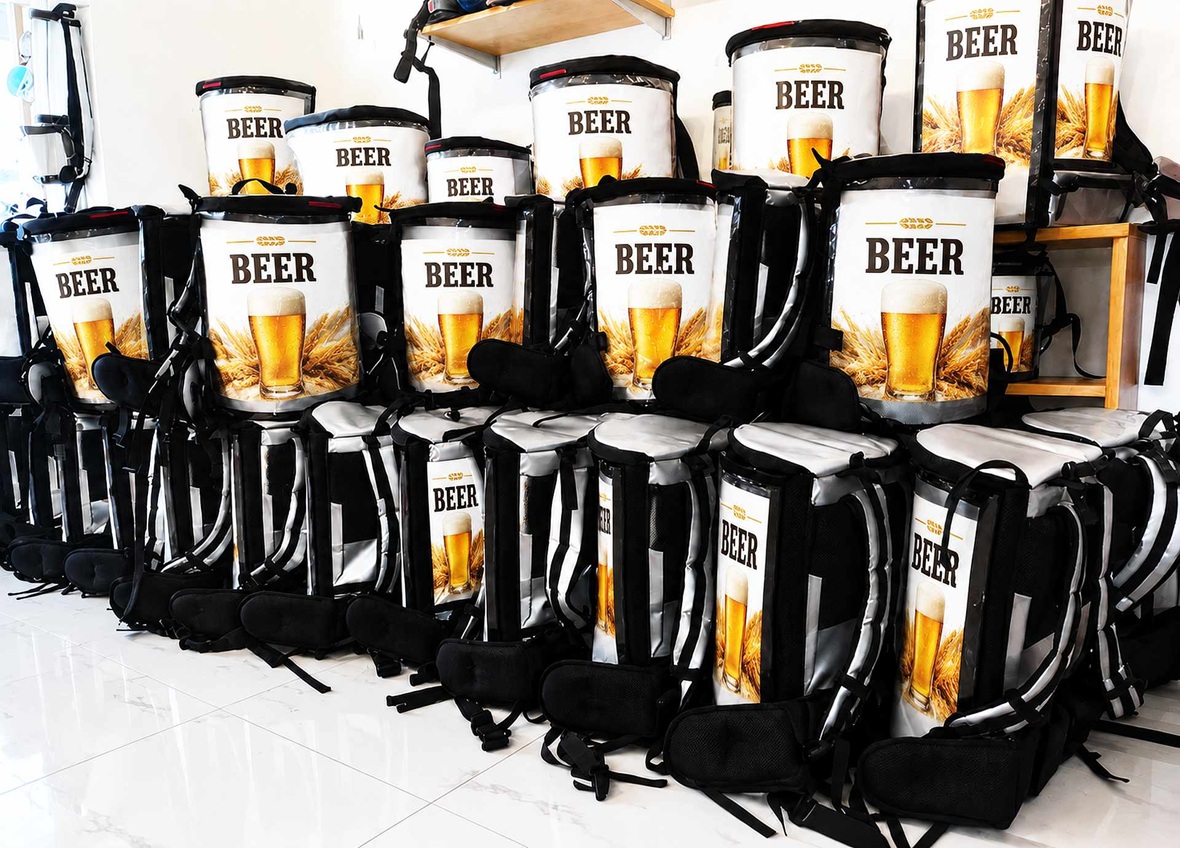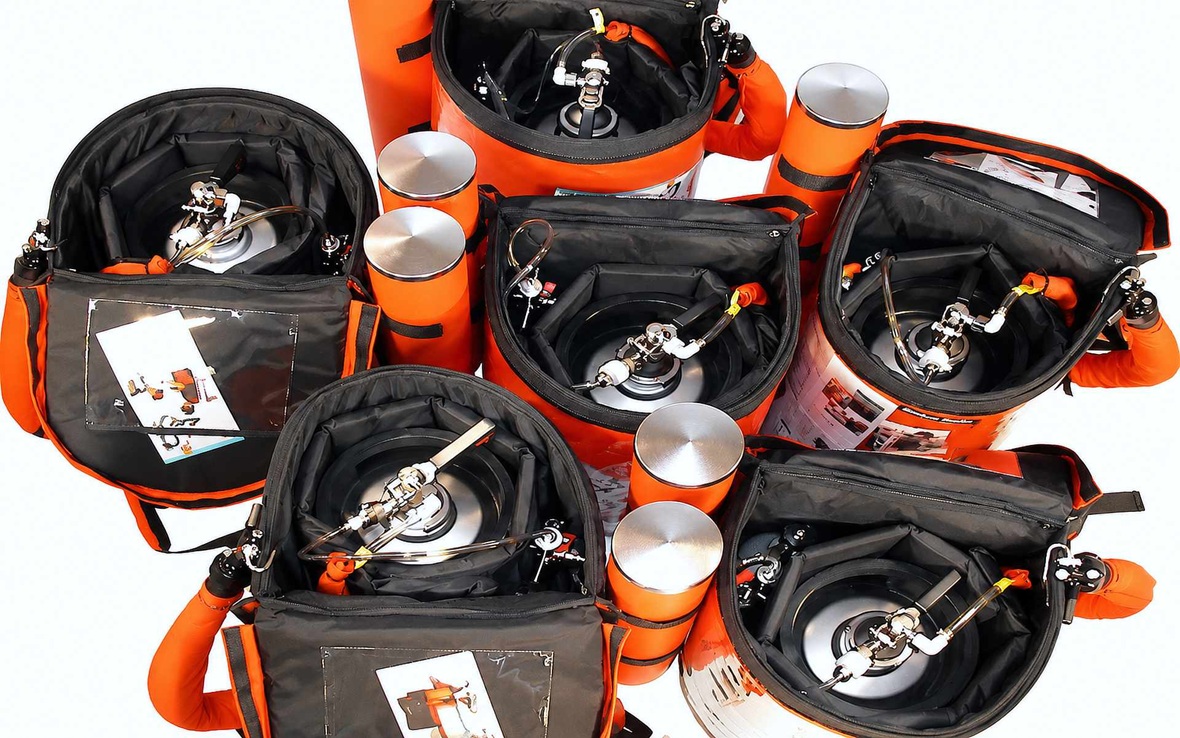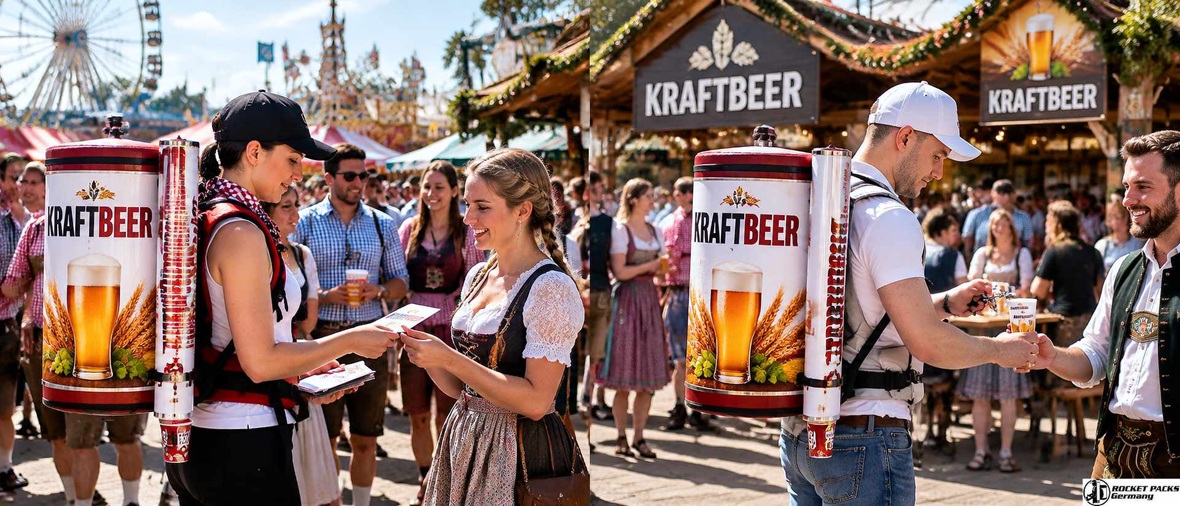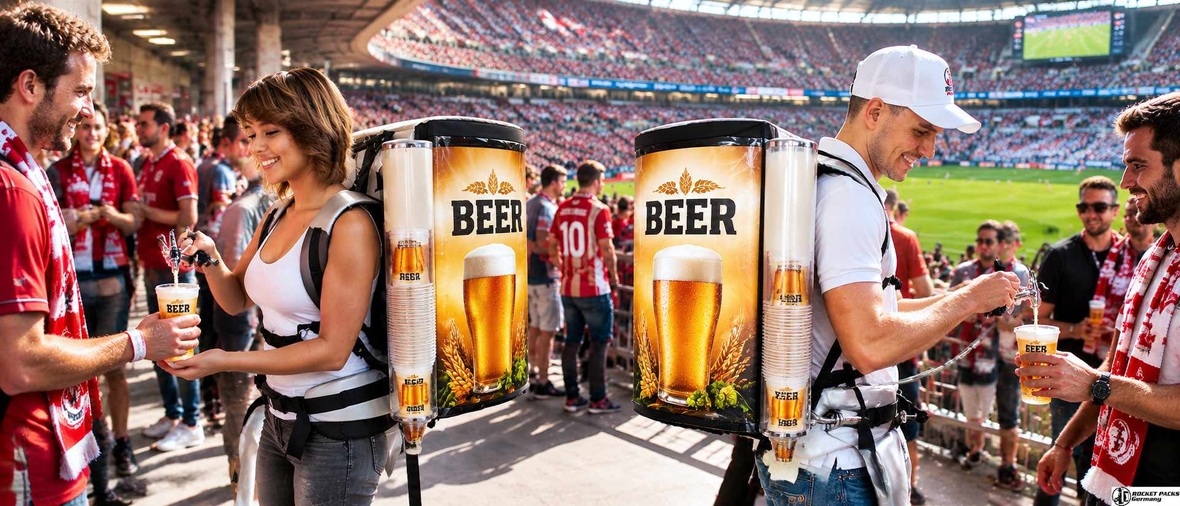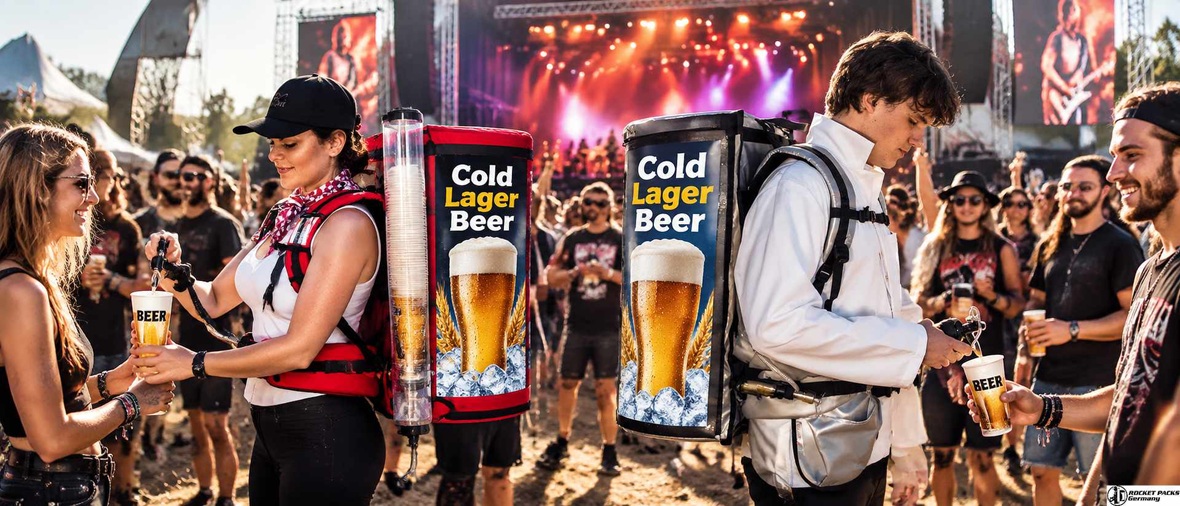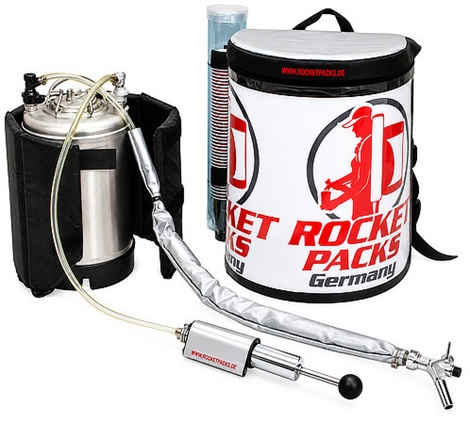
The Premium 11-litre beer backpack is designed for mobile service from a stainless-steel beverage container. Beer dispensing requires more preparation than serving a still drink because filling method, beverage temperature, pressure, tap adjustment and movement of the operator all influence the pour.
Why is the Premium 11-litre version suitable for mobile beer service?
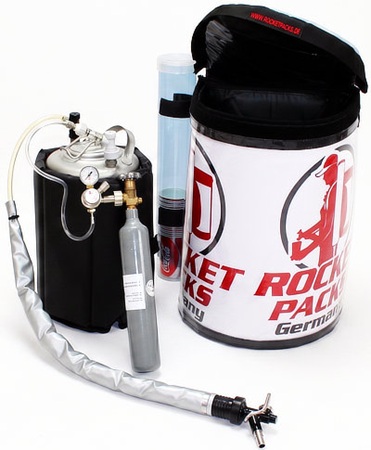
The system combines a pressure-capable stainless-steel container with a beverage line, carrying cover and selectable dispensing tap. This allows beer to be poured away from a fixed bar while the operator carries the prepared supply on the back.
The backpack does not replace the complete event infrastructure. Chilled beer, clean refill equipment, cups, cleaning facilities and trained staff must still be available at a fixed preparation point.
Why should the beer container not be filled completely?
A pressurised beverage container requires free space above the liquid. Filling approximately 80 percent of an 11-litre tank leaves a pressure chamber and results in a practical beer quantity of about nine litres.
Overfilling reduces the available pressure space and can force liquid into parts intended for gas or pressure control. The working fill must always match the pressure method and equipment supplied with the backpack.
How many portions can be obtained from a working fill of about nine litres?
A nine-litre working quantity theoretically provides thirty portions of 0.3 litres. The actual number will usually be slightly lower because beer remains in the line, test pours are required and foam or spillage can reduce the saleable quantity.
For smaller tasting portions, the number increases accordingly. Event calculations should use the intended cup fill rather than the nominal cup size, especially when a defined foam head is part of the serving standard.
Why must the beer be cooled before it enters the backpack?
The backpack retains the prepared temperature for a limited period but does not contain an active beer cooler. Beer that enters the container too warm will remain difficult to dispense even when the outer cover is insulated.
Cold beer generally releases less carbon dioxide during pouring and is easier to control at the tap. The keg, transfer equipment and backpack container should therefore all be prepared so that unnecessary warming is avoided during filling.
What causes excessive foam when beer is served from the backpack?
Excessive foam usually results from an unsuitable combination of temperature, pressure, filling method, movement and tap adjustment. Increasing pressure without first identifying the cause can make the result worse.
Typical points to check are:
- beer temperature before filling,
- pressure applied to the container,
- setting of the dispensing tap,
- air or turbulence introduced during transfer,
- kinks or restrictions in the beer line,
- movement of the filled backpack before serving,
- condition and cleanliness of the tap and hose.
What is the purpose of a compensator tap?
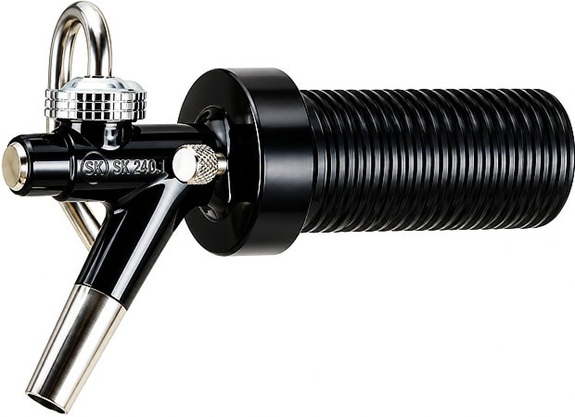
A compensator tap allows the operator to restrict and adjust the flow near the outlet. This is particularly useful for beer because the pour can be adapted to the available pressure and the behaviour of the individual product.
The tap cannot correct warm beer, an unsuitable pressure setting or a poorly filled container. It is one part of the dispensing system and must be adjusted together with the other operating conditions.
When is a premium tap preferable to a standard tap?
A premium tap is preferable when the operator needs finer control over flow and foam. This is normally the more suitable choice for beer, especially when different products or changing event conditions require adjustment during service.
A standard tap provides less regulation at the point of dispensing. The required version should be specified when ordering because the selected tap affects operation, staff training and the expected pouring procedure.
Can the dispensing pressure be produced with a hand pump?
A hand-operated pump can generate the pressure required to move beer from the container to the tap. The operator pumps when the flow becomes weaker as the liquid level falls.
This method introduces air rather than carbon dioxide into the pressure space. It is a simple mobile arrangement, but it does not replace carbon dioxide that leaves the beer during storage, movement or dispensing. The filled beer should therefore be used within the planned service period rather than kept under air pressure for an unnecessarily long time.
When should a carbon-dioxide configuration be considered?
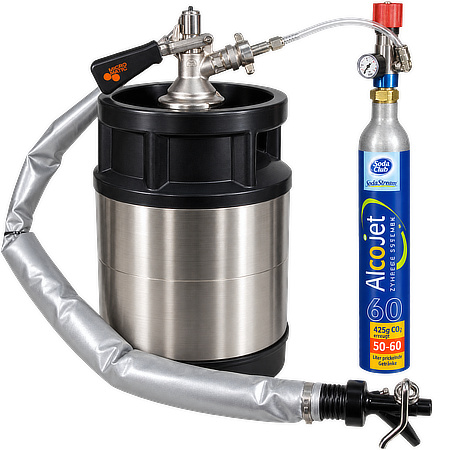
A carbon-dioxide configuration should be considered when the dispensing concept requires pressure to be maintained with CO₂ rather than air. This can be relevant when carbonation stability and a consistent pressure supply are important for the selected beer and operating period.
The system requires a suitable regulator, pressure line, connections and secure mounting of the cylinder. The exact pressure cannot be prescribed universally because it depends on beer temperature, carbonation, equipment and tap setting.
Does more pressure make the beer pour faster and better?
More pressure does not automatically improve the pour. Pressure must be high enough to transport the beer through the line, but excessive pressure can accelerate the stream and promote uncontrolled foam formation.
Adjustment should begin conservatively. The operator should observe the stream, tap response and foam level, then change only one factor at a time. Pressure must never exceed the limit permitted for the container and connected components.
How can beer be transferred from a commercial keg into the backpack container?
Beer can be transferred through suitable filling equipment connected to the keg and the Rocketpacks beverage container. A closed transfer arrangement can reduce turbulence and unnecessary loss of carbon dioxide compared with pouring beer openly through the container opening.
The dispensing head must match the keg fitting. Flat, basket and combination keg connections are not interchangeable, so the required coupler type has to be identified before the filling equipment is selected.
Can the stainless-steel container also be filled through its opening?
The container can be filled through its opening when the beverage and operating procedure permit open transfer. The beer should be introduced slowly so that splashing and foam are kept as low as possible.
Open filling exposes the product to air and creates more movement than a controlled closed transfer. It may be sufficient for a short event, but the practical result should be tested with the actual beer before several backpacks are prepared.
Why should the filled backpack be handled calmly?
Strong movement agitates the beer and can release dissolved carbon dioxide. Running, dropping the backpack onto a table or repeatedly swinging it while putting it on may lead to a foamy first pour.
After filling and transport, the unit should stand upright for an appropriate settling period. The required time depends on how much the beer was moved and how sensitively the particular product reacts.
How should the first beer after filling be handled?
The first pour should be treated as an operating check rather than being handed directly to a customer. It removes air from the beverage line and shows whether the temperature, pressure and tap setting are suitable.
The operator should check whether the stream is continuous, whether the tap closes correctly and whether the foam level is manageable. Corrections should be completed at the preparation point before the backpack enters the customer area.
Do different beer styles require different settings?
Different beers can require different handling because carbonation level, serving temperature and foam behaviour are not identical. A setting used successfully for a lager may not produce the same result with wheat beer, ale or another speciality beer.
We recommend testing every beer selected for an event rather than transferring a previous setting without verification. This also applies when several breweries supply products with similar names or alcohol content.
Can alcohol-free beer be dispensed with the same equipment?
Alcohol-free beer can be dispensed when the complete configuration is suitable for a carbonated beverage. The absence of alcohol does not remove the need to control temperature, pressure and foam.
Product-specific testing remains necessary. Alcohol-free beers can differ considerably in carbonation and composition, so their behaviour should not be assumed to match the alcoholic version from the same brewery.
Why is the Premium 11-litre model a single-beverage system?
The Premium 11-litre version contains one beverage container and one connected product path. It therefore serves one beer at a time.
Changing to another beer requires the remaining product to be removed and the complete contact path to be cleaned. Two beers should not be mixed in the same tank, and a line previously used for one product should not be connected to another without the necessary cleaning procedure.
Which parts retain beer residues after service?
Beer remains not only inside the container but also in the outlet, couplings, hose and internal passages of the tap. Foam, proteins, yeast and other residues can dry onto these surfaces when cleaning is delayed.
The complete beer route must therefore be included:
- stainless-steel container,
- container closure and seals,
- beverage outlet and couplings,
- beer line,
- tap body and internal flow path,
- removable tap components where applicable.
How should the beer line be cleaned after an event?
The line must be flushed and cleaned with a product suitable for beverage and beer dispensing equipment. The cleaning liquid has to travel through the same route as the beer so that the hose and tap are treated internally.
After the required contact procedure, the complete path must be rinsed with clean water until no cleaning-agent residue remains. The container and line should then drain and dry before being closed for storage.
Why must pressure be released before the container is opened?
A pressurised container must be fully depressurised before the closure, hose or pressure connection is loosened. Opening a component while pressure remains inside can cause the closure or liquid to move unexpectedly.
The backpack should stand securely on a suitable surface during depressurisation. The operator must not attempt to dismantle the system while wearing it, and damaged pressure fittings or seals must be replaced before further use.
What should be checked before the beer backpack is given to an operator?
The assembled system should pass a complete function and leakage check before it is lifted onto the wearer.
- container filled only to the approved working level,
- closure and seals correctly positioned,
- pressure line and beverage line securely connected,
- CO₂ cylinder secured where included,
- tap closes without dripping,
- beer flows with a controllable foam level,
- hose is routed without a sharp bend,
- waist, chest and shoulder straps are adjusted,
- cup dispenser is loaded with the tested cup format.
Which operating details should be provided when requesting a beer backpack?
A precise enquiry should describe the beer service rather than requesting only an 11-litre dispenser.
- beer type and brewery product,
- carbonation and required serving temperature,
- preferred hand-pump or CO₂ operation,
- standard or compensator tap,
- method used to fill from the original keg,
- cup volume and rim diameter,
- planned working time per filling,
- number of operators and backpacks,
- country of use and event date.
These details allow us to select the pressure and filling equipment for the actual application instead of assuming that one beer configuration is suitable for every product.