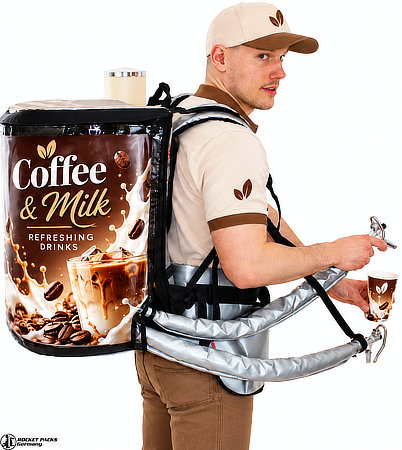
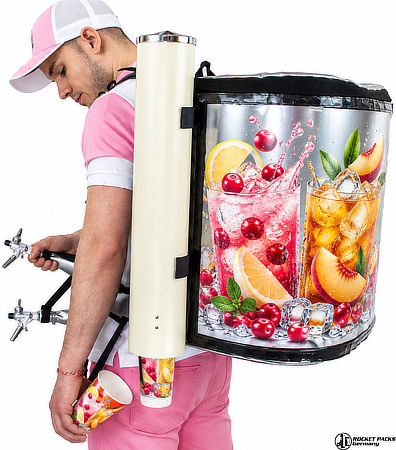
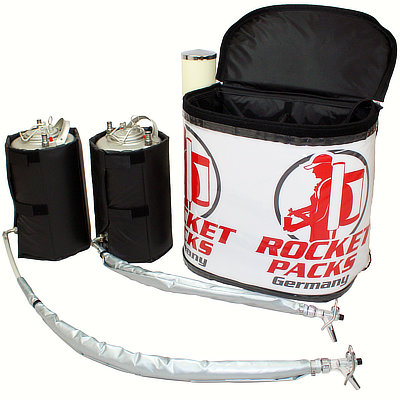
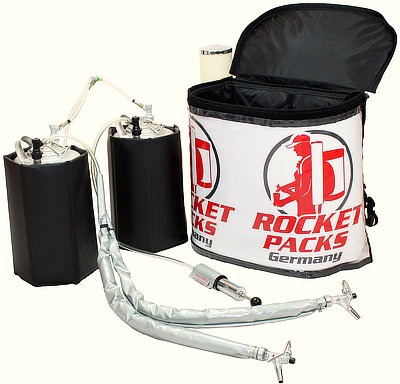
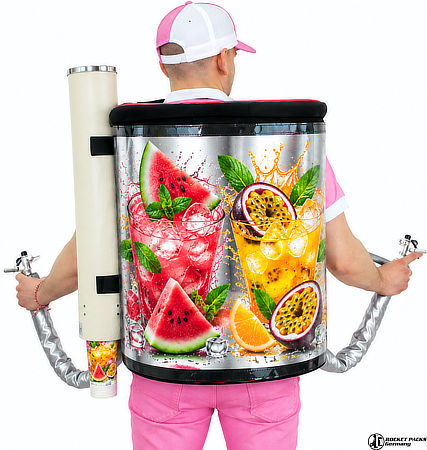
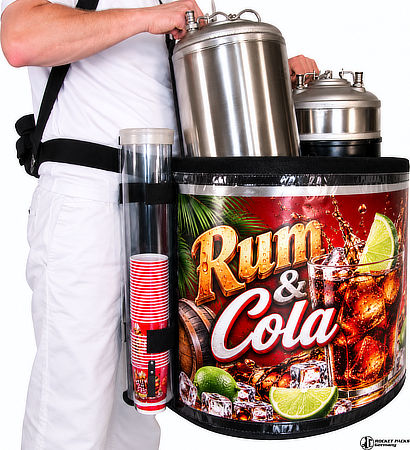
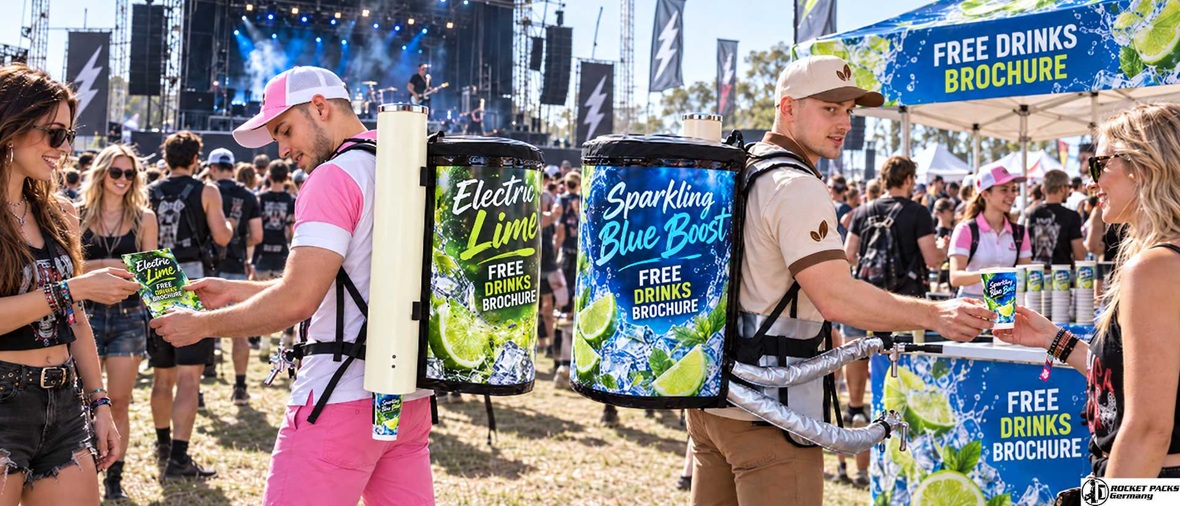
The Coffee Backpack Kombi is a dual-container system for serving two beverages independently from one wearable unit. It contains two stainless-steel tanks, separate beverage paths and two taps, allowing the operator to carry either two different drinks or a larger divided supply of the same beverage. :contentReference[oaicite:0]{index=0}
What is the main advantage of using two beverage containers?
Two containers allow the contents of each side to be selected, filled and dispensed separately. One tank can hold coffee while the second contains another compatible drink, or both tanks can be filled with the same product when a larger mobile quantity is required.
This separation also makes it possible to stop using one beverage without opening or emptying the other tank. The practical benefit depends on whether the event genuinely requires two products; carrying an unused second supply only adds weight.
Can coffee and milk be carried in the two tanks?
Coffee and a suitable milk-based beverage can be assigned to separate tanks when the complete handling procedure has been prepared for both products. The two-product arrangement is specifically presented as one possible use of the Kombi system. :contentReference[oaicite:1]{index=1}
Milk requires stricter temperature control and more immediate cleaning than black coffee. The organiser must decide whether milk will be served directly from the backpack or provided separately in smaller portions. Carrying milk is only sensible when it can remain within the required handling conditions throughout the mobile round.
Can the two tanks contain different types of coffee?
The system can dispense two separately prepared coffee products because each container has its own beverage route. For example, one side may contain regular coffee and the other a different recipe, provided that both remain clearly identifiable.
The operator needs an unambiguous assignment of tap, tank and product. Labels at the preparation point and a simple left-side or right-side instruction help prevent the wrong drink from being handed to a customer.
Why should the fill quantity be planned separately for each tank?
The two products will rarely be requested in exactly the same proportion. Filling both containers with eleven litres may create unnecessary residual beverage when one drink is ordered much less frequently.
A previous sales estimate or a short event trial can be used to divide the working quantity. When expected demand is approximately two portions of coffee for every one portion of the second drink, the starting fills can reflect that relationship instead of treating both tanks identically.
Does the nominal capacity mean that 22 litres must always be carried?
No. The system provides two tanks with a nominal capacity of eleven litres each, but the actual working fill can be lower. The appropriate quantity depends on demand, route duration, beverage temperature and the assigned wearer. :contentReference[oaicite:2]{index=2}
Using partial fills can shorten the mobile round and reduce physical strain. It also allows the reserve beverage to remain in the appropriate preparation equipment until the next refill is required.
How heavy is the backpack when both containers are full?
The empty Kombi system weighs approximately eleven kilograms, and the documented total weight with both tanks fully filled is about thirty kilograms. Accessories and items carried in the apron may add further weight. :contentReference[oaicite:3]{index=3}
A full load should therefore be treated as a high-capacity configuration rather than the standard choice for every operator. Route length, stairs, working time and individual physical ability must be considered before the filling quantity is established.
What happens when one tank empties faster than the other?
The load becomes increasingly uneven when one side loses considerably more beverage than the other. The wearer may notice that the backpack pulls towards the fuller container or moves differently while turning.
The service plan should anticipate this effect. When one product has much higher demand, the initial quantities can be adjusted, or the operator can return before the weight difference becomes uncomfortable. Refilling only one side is possible, but the complete load must be checked again before the next round.
How are still hot drinks dispensed from the two containers?
Still beverages can flow from the separate tanks by gravity without additional pressure equipment. Each container feeds its assigned line and tap, allowing the operator to control the drinks independently. :contentReference[oaicite:4]{index=4}
Correct container position and an unobstructed beverage path remain necessary. A kinked line, blocked valve or insufficient air balance can interrupt one side even while the other side continues to operate normally.
Why does each beverage need its own tap and line?
Separate product paths prevent the two drinks from mixing inside the backpack. They also allow each tap to be operated according to the beverage assigned to that side.
This separation must continue during filling and cleaning. Connecting a line to the wrong tank can result in incorrect product identification, unwanted flavour transfer or a serving error that is difficult for the operator to recognise once the backpack is closed.
How can the two dispensing sides be distinguished during service?
The simplest method is a fixed left-and-right assignment supported by visible labels. The same identification should appear on the tank, line, tap and refill vessel.
Relying only on hose position is risky when the system is taken apart for cleaning or several backpacks are prepared at the same time. Colour-coded tags or clearly written product names can make reassembly and staff handover more reliable.
Can the two beverages be combined in one customer cup?
Two products can be dispensed consecutively into the same cup when the recipe and serving procedure require it. The operator controls the quantity from each tap separately.
This does not create an automatic mixing system. The portion ratio depends on the operator’s tap movement, so the combination should be practised before the event. A defined fill mark or measured training portions can improve consistency.
How should the serving sequence be organised for a two-component drink?
The sequence should be fixed so that every operator prepares the drink in the same order. The beverage with the larger portion is often dispensed first, followed by the smaller component, but the correct order depends on the recipe and desired presentation.
The trial should check whether the cup remains stable, whether splashing occurs and whether both taps can be reached without twisting the wearer’s upper body. A recipe that works at a counter may need to be simplified for mobile service.
Can both tanks hold beverages at different temperatures?
The tanks are separate and individually insulated, so different prepared beverages can be carried independently. However, the practical temperature result depends on the starting temperature, quantity, ambient conditions and time in service. The documented passive insulation period is up to approximately three hours under suitable conditions. :contentReference[oaicite:5]{index=5}
Temperature-sensitive products should be measured at the outlet rather than judged from the tank exterior. Coffee remaining inside the exposed part of a line may change temperature faster than the larger volume inside its insulated container.
Why is preheating the stainless-steel tanks useful?
Preheating reduces the immediate transfer of heat from freshly prepared coffee into a cold container. The operating instructions recommend warming the steel tank with hot water before filling it with a hot beverage. :contentReference[oaicite:6]{index=6}
The preheating water must be emptied completely before the drink is added. The procedure is intended to prepare the tank, not to dilute the finished coffee or correct an unsuitable brewing temperature.
Why must coffee be filtered carefully before filling?
Coffee particles can obstruct valves and restrict the beverage flow. The manufacturer therefore recommends filtering the drink again during transfer into the container when necessary. :contentReference[oaicite:7]{index=7}
This is particularly important in a dual-tank system because a blockage may affect only one side and appear at first to be a tap or pressure problem. Increasing pressure does not remove coffee grounds trapped in a narrow product passage.
What should be checked when only one tap produces beverage?
The affected side should be examined independently. Confirm that the correct beverage line is locked onto the outlet valve, the hose is not compressed and the tap adjustment has not been closed too far.
Also check the container lid, air-balancing function and beverage consistency. If the product contains insufficiently dissolved powder or coffee particles, the line may require cleaning before service can continue. The functioning second side does not prove that both tanks were assembled correctly. :contentReference[oaicite:8]{index=8}
When would pressure equipment be needed?
Additional pressure equipment is required when the selected beverage cannot be served through the confirmed gravity arrangement or when a carbonated application is planned. The documented Kombi configuration can be equipped with a manually operated air pump and T-coupler. :contentReference[oaicite:9]{index=9}
The gas and beverage connections must not be interchanged. Pressure must be released completely before a container lid or pressure connection is opened, and the permitted operating pressure of the supplied components must never be exceeded.
How should two independent beverage circuits be cleaned?
Each tank, valve, hose and tap must be cleaned as a complete product path. Cleaning one container does not clean the line belonging to the other side.
The cleaning procedure should therefore be performed separately for both circuits:
- empty and rinse each stainless-steel container,
- prepare a suitable cleaning solution,
- pass the solution through the corresponding hose and tap,
- rinse the tank and dispensing route thoroughly with clean water,
- allow the components to drain and dry before storage.
The operating instructions require the tanks, valves, hoses and dispensing taps to be cleaned and sanitised after use. :contentReference[oaicite:10]{index=10}
Why should coffee and milk circuits retain fixed assignments?
A fixed assignment reduces flavour transfer and simplifies hygiene control. The line previously used for milk should not be treated as clean for black coffee merely because the tank has been emptied.
Where the two product types are used regularly, marking the complete circuits can prevent accidental exchange after cleaning. Tank, hose and tap should remain associated with the same side unless every component has been cleaned and intentionally reassigned.
What does the reinforced backpack construction contribute?
Aluminium struts incorporated into the back help stabilise the two-container structure. This is relevant because the load is wider and heavier than that of a single-tank system. :contentReference[oaicite:11]{index=11}
The reinforcement does not replace correct carrying adjustment. The waist belt should take most of the load, while the shoulder and chest straps keep the upper section close to the wearer’s body.
How much operating space does the dual-tank model require?
The documented backpack dimensions are approximately 52 centimetres high, 52 centimetres wide and 32 centimetres deep. The wearer additionally needs room for both arms, the dispensing lines, taps and cup handling. :contentReference[oaicite:12]{index=12}
The route should be tested through doors, aisles, service entrances and any seating areas included in the assignment. The comparatively wide construction may be appropriate for open event zones but less practical in confined customer areas.
How can the large advertising surface be used?
The rear transparent area accepts a replaceable printed insert measuring approximately 44 by 91 centimetres within the visible foil surface. The larger outer branding area is approximately 48 by 96 centimetres. :contentReference[oaicite:13]{index=13}
The design should identify the beverages clearly when two products are offered. Important logos and product names should remain away from curved edges and should be tested on the fully loaded backpack before the final print quantity is produced.
Which details must be fixed before a dual-tank coffee system is configured?
The project must define both beverage circuits separately rather than describing only a general coffee service.
- product assigned to the first container,
- product assigned to the second container,
- ingredients and required serving temperatures,
- planned quantity in each tank,
- individual or combined serving procedure,
- portion size and cup dimensions,
- gravity or pressure-assisted operation,
- standard or adjustable tap requirements,
- expected route and refill interval,
- number of backpacks and assigned operators.
These details determine whether the two-container arrangement provides a useful operational advantage or whether separate smaller systems would create a more manageable service process.