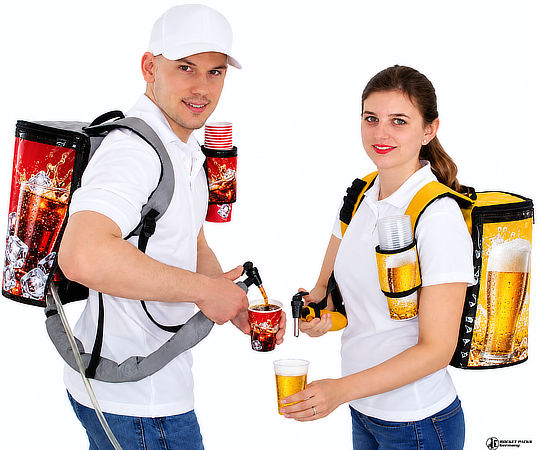
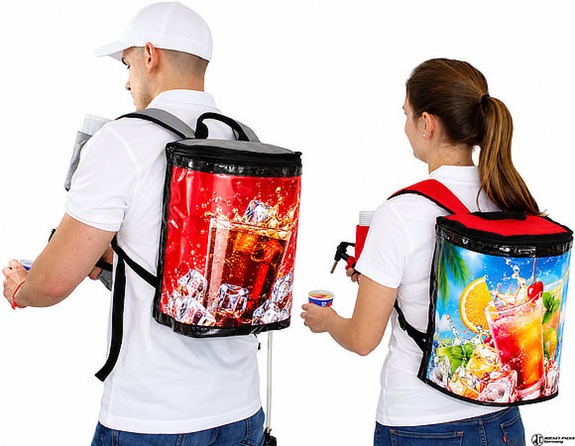
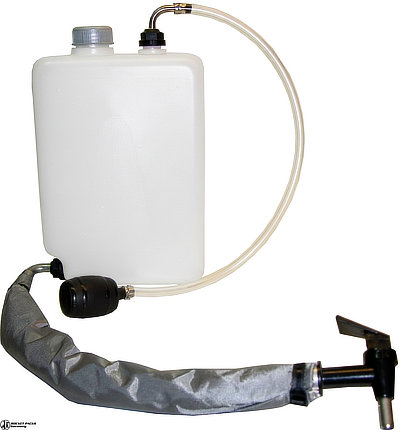
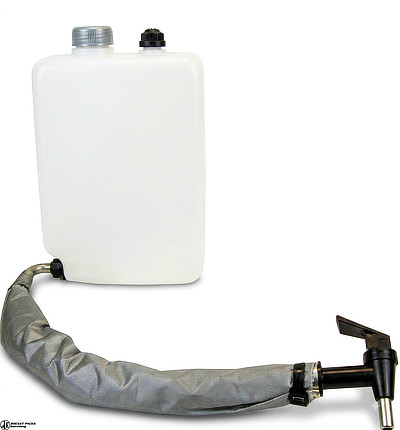
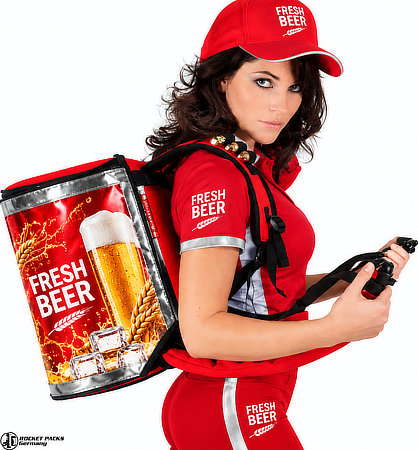
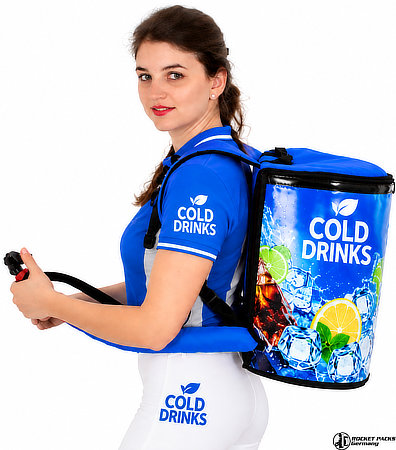
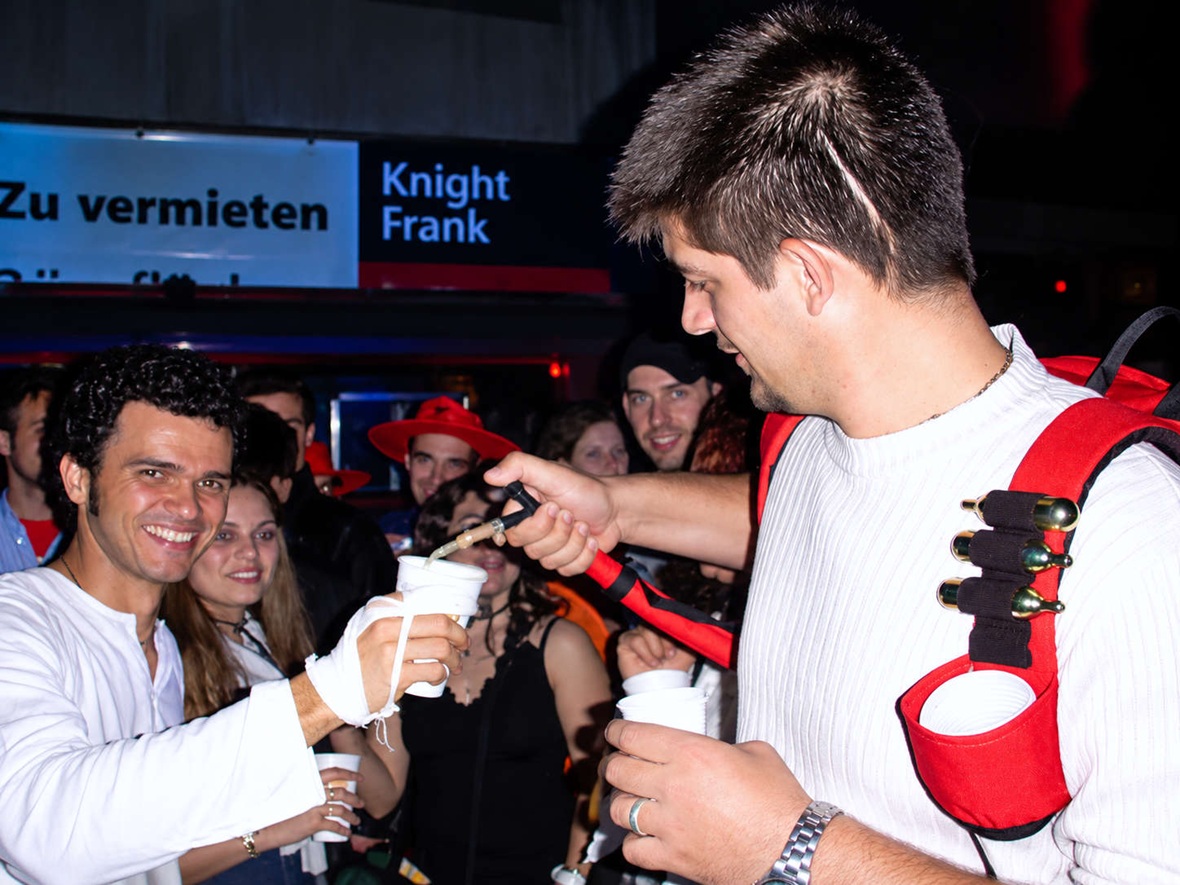
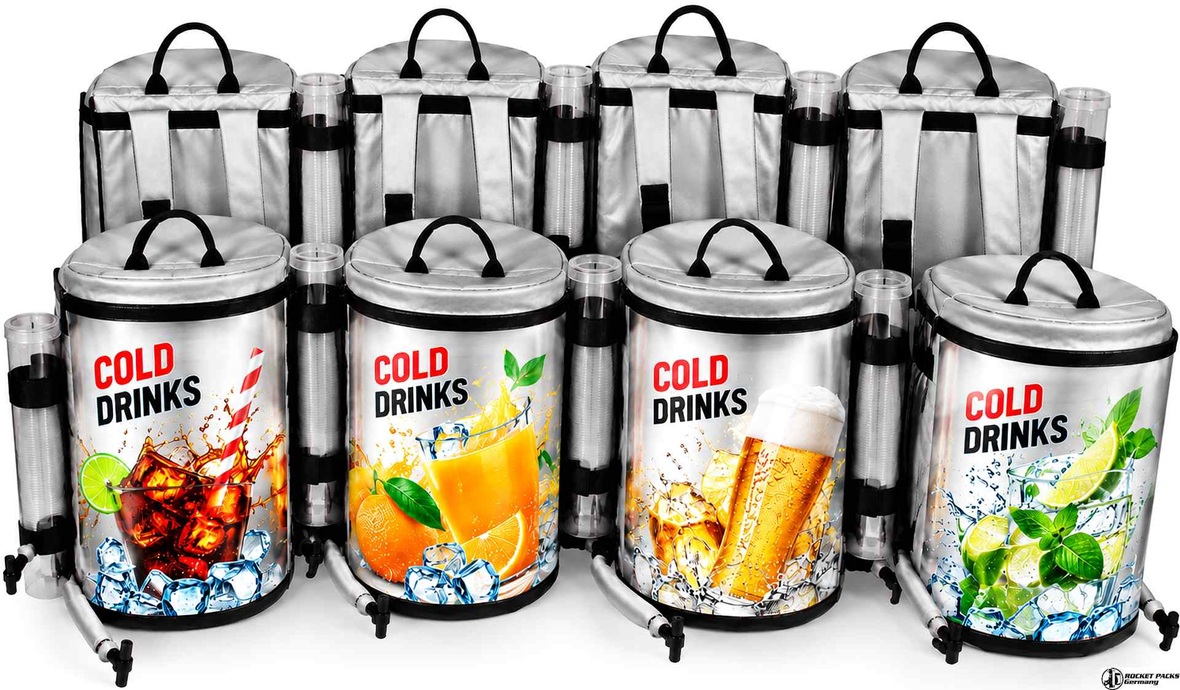
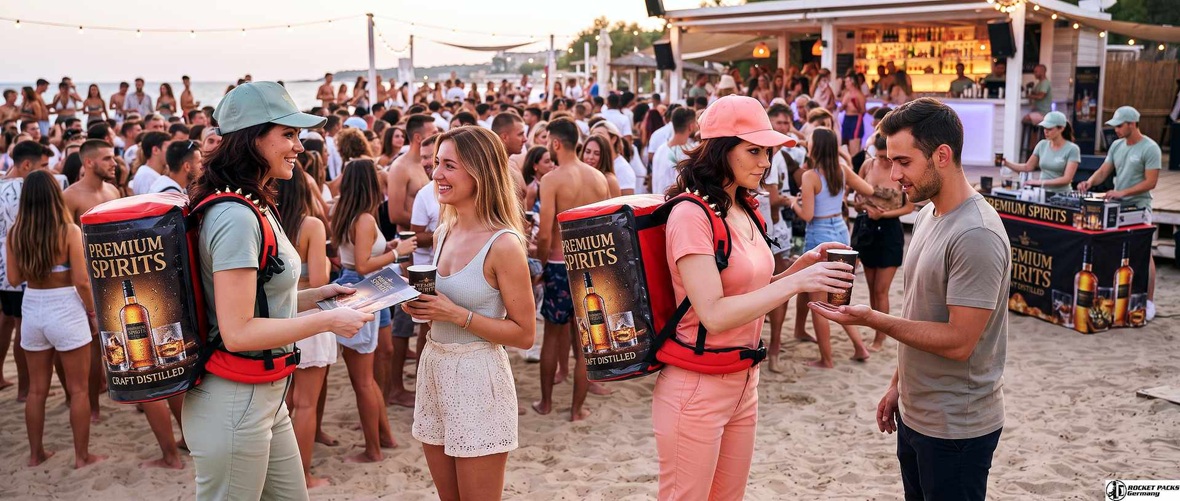
The Drink-Pack-Fun is a compact beverage backpack with a refillable 5-litre plastic container. It is intended primarily for cold drinks, short serving rounds, private events, leisure activities and small promotional applications. Still beverages are dispensed by gravity, while the version for carbonated drinks uses a manually operated mini air pump. :contentReference[oaicite:0]{index=0}
For which applications is the Drink-Pack-Fun intended?
This model is suitable when five litres provide enough beverage for one operating round and a larger professional system would create unnecessary weight or capacity. Possible uses include private celebrations, picnics, small outdoor events, club activities and limited product-sampling campaigns.
It is not designed to replace a high-capacity catering station. Reserve beverages, refilling and cleaning still need an organised location away from the serving area.
How does this model differ from the Premium 5-litre backpack?
The Drink-Pack-Fun uses a lightweight plastic beverage container and a more compact backpack construction. The Premium 5-litre model has a stainless-steel container, a larger cover and other equipment options.
The Drink-Pack-Fun is therefore the simpler choice for moderate use with preferably cold beverages. Projects requiring a more substantial container, longer service rounds or specialised dispensing equipment should be assessed separately.
How is a still drink dispensed without a pump?
Still beverages leave the container through the lower beverage connection and flow towards the tap by gravity. The pressure-balancing fitting allows air to enter the tank while liquid is removed.
The backpack must be worn in the correct position so that the container remains above the dispensing tap. A kinked hose, blocked air-balancing fitting or incorrectly fitted lid can weaken or stop the flow. :contentReference[oaicite:1]{index=1}
What equipment is required for a carbonated beverage?
The carbonated version requires the supplied mechanical mini air pump. The operator uses it to create the pressure needed to move the drink from the container through the beverage line.
The correct version must be selected when ordering. A gravity-only backpack should not be converted with unrelated pumps, connectors or pressure components.
Does the mini air pump maintain the carbonation of the drink?
The pump generates dispensing pressure with air; it does not add carbon dioxide to the beverage. It therefore moves the drink but does not replace CO₂ that is released through filling, movement or dispensing.
Carbonated beverages should be filled cold, handled calmly and consumed within the planned service period. The system should be tested with the actual drink because beer, sparkling water and soft drinks can produce different amounts of foam.
How is the five-litre container filled?
The container is removed from the backpack cover and filled through its opening. Only open filling is provided for this version. The connected beverage line should remain attached during normal filling and dispensing unless the operating instructions require removal for maintenance.
After filling, the lid must sit evenly and the container must be returned to the correct position inside the cover. A test portion should be dispensed before the backpack is placed on the wearer. :contentReference[oaicite:2]{index=2}
Which drinks are most suitable for the Drink-Pack-Fun?
The model is preferably intended for cold, pourable beverages. Water, lemonade, juice drinks, wine-based mixtures and other suitable still drinks can be served in the gravity version. Carbonated products require the corresponding pump configuration.
Drinks containing fruit pieces, thick ingredients or sediment can obstruct the outlet, hose or tap. Undiluted spirits with a high alcohol content are excluded from the stated range of applications. :contentReference[oaicite:3]{index=3}
Can coffee or another hot drink be used?
The Drink-Pack-Fun is not the primary Rocketpacks model for professional hot-drink service. The product information describes it as preferably suitable for cold beverages.
Before using a warm or hot drink, the permitted filling temperature and compatibility of the container, hose, seals and tap must be confirmed. A stainless-steel Premium or Pro model may be more appropriate when temperature retention and repeated commercial use are important.
How many servings can be obtained from five litres?
Five litres provide a theoretical maximum of 25 portions when each cup contains 200 millilitres. The practical result is lower because beverage remains in the tank and hose, and small quantities may be lost through test pours, foam or spillage.
The intended portion should be measured during a trial. Filling cups by eye can produce considerable differences over a complete service round.
Must the container always be filled completely?
A complete five-litre filling is not necessary when fewer servings are expected. The working quantity should correspond to the route, demand and number of available cups.
A smaller fill reduces the load but can move more strongly inside the container while the operator walks. The selected quantity should therefore be tested with the backpack worn and the beverage line positioned as it will be during use.
What does moderate insulation mean?
The backpack slows temperature change but does not actively cool or heat the beverage. Drinks must already have the required serving temperature when the container is filled.
Ambient temperature, direct sunlight, filling quantity and operating time influence the result. For longer events, reserve drinks should remain in suitable refrigeration until the next refill is needed.
Which cups can be carried on the backpack?
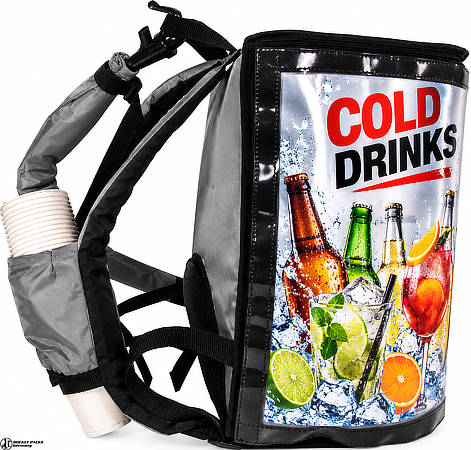
The cup holder integrated into the shoulder strap is intended primarily for cups of approximately 200 millilitres. The actual cup must still be tested because rim diameter, wall stiffness and nesting depth influence whether individual cups can be removed reliably. :contentReference[oaicite:4]{index=4}
A complete stack from the intended delivery should be used for the test. One loose sample does not show whether several nested cups will jam or fall out while the operator moves.
How much space does the backpack require?
The stated backpack dimensions are approximately 36 centimetres high, 27 centimetres wide and 17 centimetres deep. The operator also needs space for the arms, cup holder and dispensing movement. :contentReference[oaicite:5]{index=5}
Narrow doors, seating rows and crowded passages should be tested with a filled unit. The compact dimensions help in confined areas, but they do not remove the need for a safe stopping position during dispensing.
How can an advertising design be inserted?
The transparent outer sleeve accepts a replaceable printed insert. The visible advertising area is approximately 31 centimetres high and 46 centimetres wide. :contentReference[oaicite:6]{index=6}
The design should be checked on the filled backpack because the surface curves around the container. Product names and logos should remain away from seams and edges where they may be partly concealed.
Can a commercial five-litre beer can be installed instead of the refillable tank?
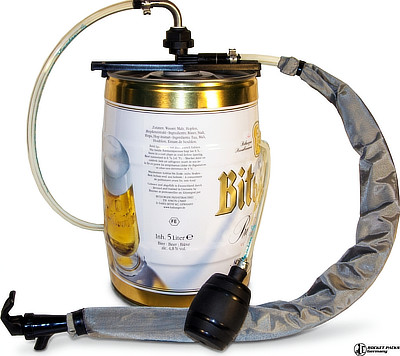
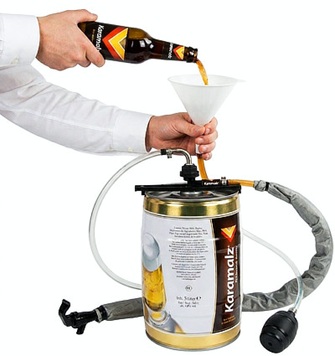
A separate tapping configuration is available for compatible five-litre beer cans. This is not the same arrangement as the standard refillable plastic container.
The beer-can version requires a suitable tapping set, beverage line and pump. Only cans fitted with the required rubber stopper can be connected, and the beer can itself is not supplied with the backpack. :contentReference[oaicite:7]{index=7}
Why must the exact beer-can type be checked in advance?
Five-litre party kegs do not all have the same closure or connection. A can without the compatible rubber stopper cannot be connected merely because its nominal capacity is five litres.
A photograph of the closure or an empty sample can help identify whether the planned keg is compatible. The beverage brand and exact packaging version should be confirmed before the tapping equipment is prepared.
How should the system be cleaned after use?
The container, outlet, beverage hose and tap must all be included in the cleaning process. Rinsing only the visible tank interior leaves drink residue inside the line and tap mechanism.
Cleaning liquid and rinse water should pass through the same route as the beverage. Afterward, the components must drain and dry before the container is closed and stored. The manufacturer recommends cleaning before first use and after every operating period. :contentReference[oaicite:8]{index=8}
What should be checked before the backpack is put on?
The complete system should be inspected while standing securely on a suitable surface.
- The container lid sits evenly.
- The beverage hose is connected and has no sharp bend.
- The pressure-balancing fitting or mini pump is installed correctly.
- The tap opens and closes without uncontrolled dripping.
- A test portion flows as expected.
- The cup stack remains secure in the shoulder holder.
- The advertising insert is positioned correctly.
- The carrying straps are adjusted for the wearer.
When is another Rocketpacks model more appropriate?
Another model should be considered when five litres are insufficient, longer temperature retention is required or the project involves frequent professional use. Hot beverages, extended beer service and high-volume event catering can also require a stainless-steel container or more advanced pressure and tap equipment.
The Drink-Pack-Fun is intended as a compact and comparatively simple system. Selecting it solely because it is the smallest model can create unnecessary limitations when the actual service process requires more capacity or technical control.
What must be specified so that the correct version is supplied?
The request should identify the complete intended use rather than stating only that a five-litre backpack is required.
- exact beverage and ingredients,
- still or carbonated operation,
- planned filling and serving temperature,
- refillable container or compatible five-litre beer can,
- portion size and cup dimensions,
- expected number of servings per round,
- required advertising insert,
- number of backpacks,
- delivery destination and required date.
These details allow the gravity version, pump version or beer-can tapping arrangement to be distinguished before the order is prepared.