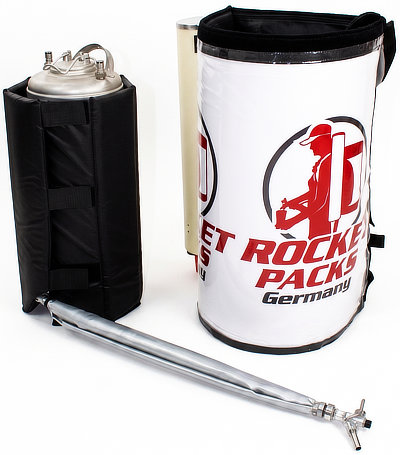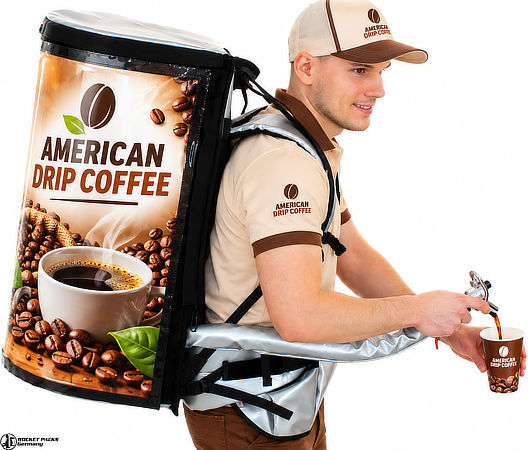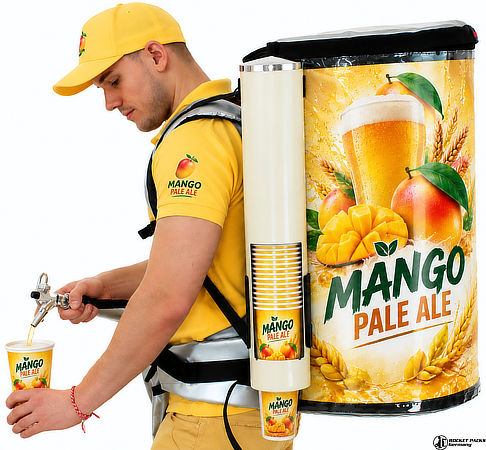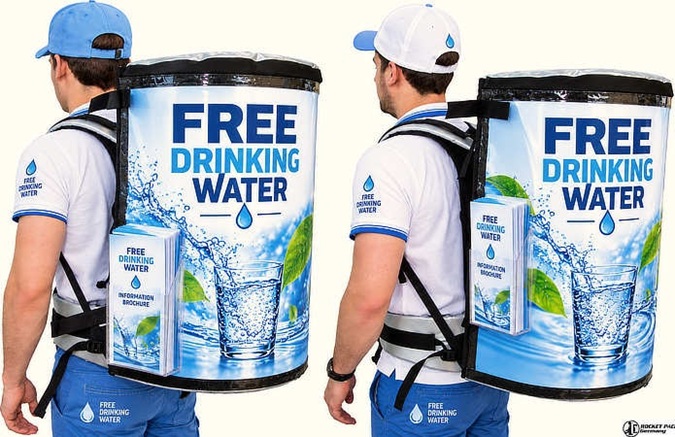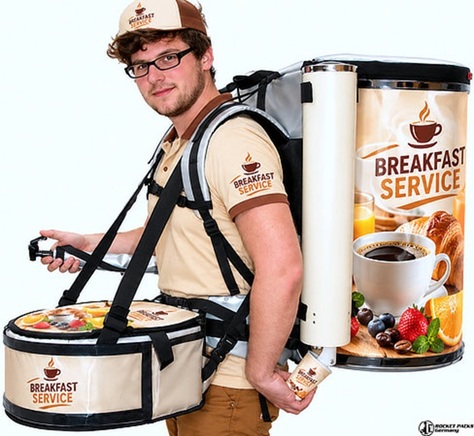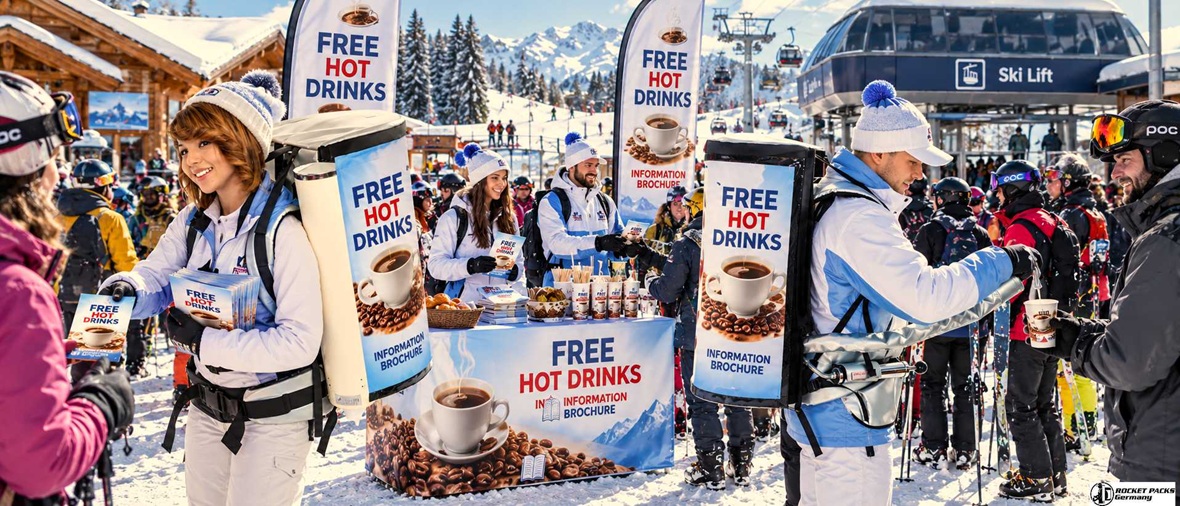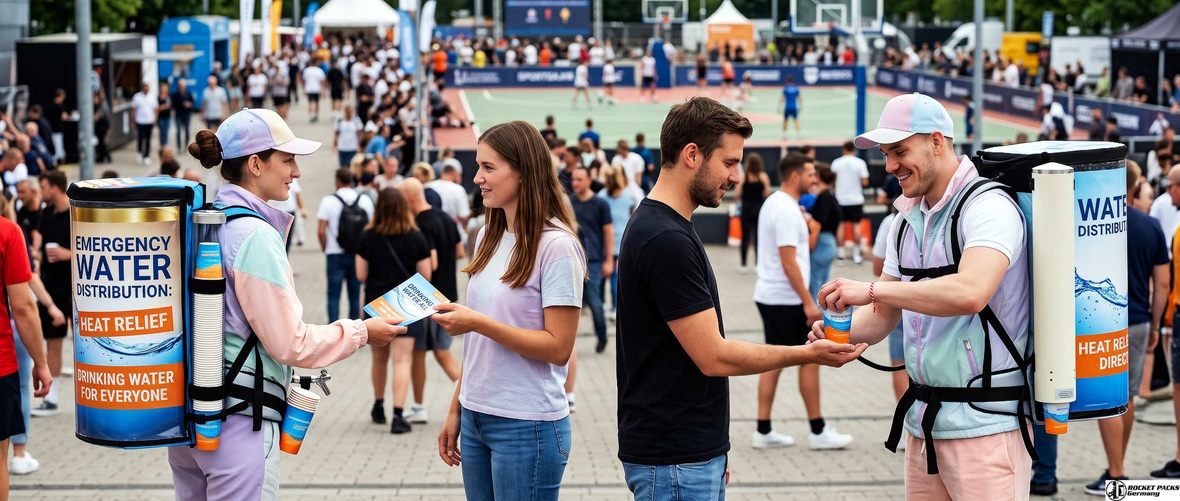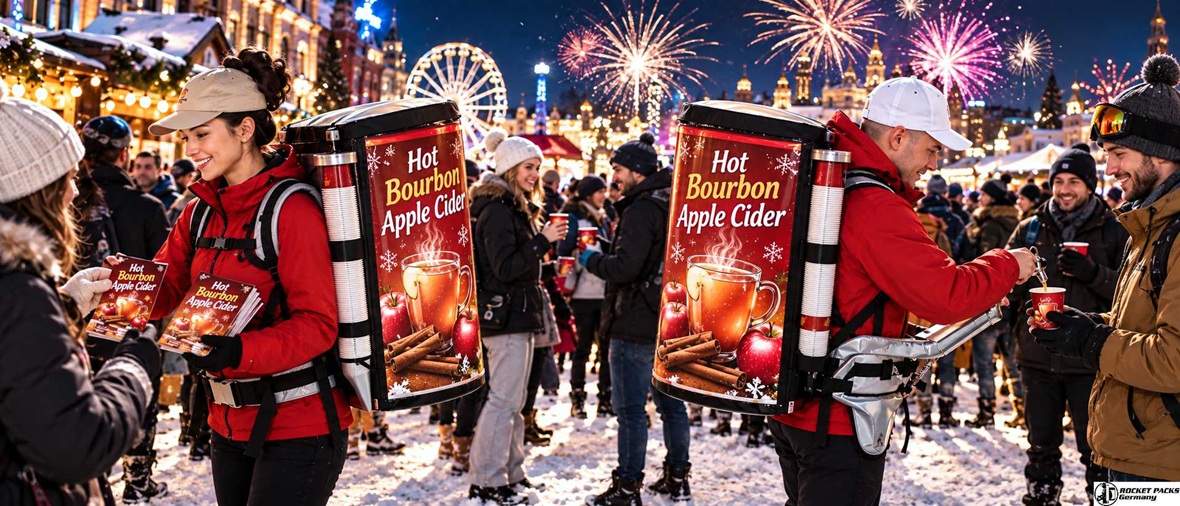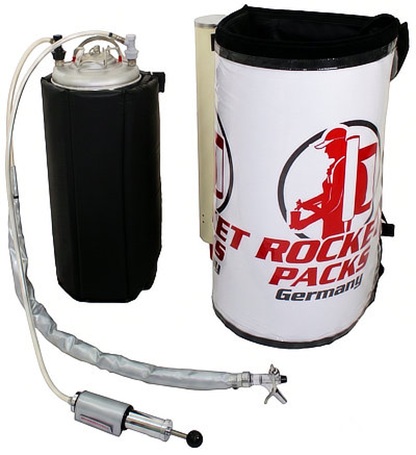
The Pro 19-litre model is intended for mobile service with a comparatively large quantity of coffee, tea or another suitable non-carbonated hot drink. Its stainless-steel container, gravity-fed beverage path, insulated line and reinforced backpack construction are designed for longer serving rounds in which capacity, temperature management and operator load must be planned together.
For which type of coffee service was the Pro 19-litre model developed?
The system is intended for events where one operator must carry a substantial prepared beverage quantity away from a fixed serving counter. Typical workflows include stadium catering, winter events, exhibitions, outdoor markets and large company functions.
The backpack does not brew coffee. A separate preparation area is still required for brewing, filling, cup storage, cleaning and reserve beverage. The mobile unit begins its function only after the drink has been prepared at the required serving temperature.
When is a 19-litre container preferable to a smaller coffee backpack?
The larger container is useful when demand is sufficiently high to serve most of the working quantity within one planned round. It reduces the number of returns to the preparation point and can support service in areas located farther away from the coffee station.
For short promotions or uncertain demand, a smaller model may be easier to manage. Carrying unused coffee for an extended period adds weight without improving the service process.
How many cups can theoretically be served from 19 litres?
The theoretical serving count depends on the actual quantity placed in each cup.
- approximately 95 portions at 200 millilitres,
- approximately 76 portions at 250 millilitres,
- approximately 63 portions at 300 millilitres.
The practical number is lower because liquid remains in the container and line, test pours may be required and individual portions are not always filled with mathematical precision. Foam is usually less relevant for black coffee, but spillage and residual beverage must still be included in the calculation.
Does the container always need to be filled with the complete 19 litres?
No. The working fill should correspond to expected demand, route length and the physical capacity of the assigned operator. Filling ten or twelve litres can be more sensible when the round is short or the beverage must be replaced frequently.
A reduced quantity changes both the carried weight and the thermal behaviour. Less coffee is easier to carry but may change temperature faster than a nearly full container. The appropriate balance should be established through a practical test.
What is the approximate operating weight with a full coffee container?
The empty Pro 19-litre system weighs approximately 8.5 kilograms. A full quantity of a water-like beverage adds about 19 kilograms, resulting in roughly 27.5 kilograms before cups, payment equipment and apron contents are included.
This load should not be assigned solely on the basis of the container capacity. Walking distance, stairs, floor conditions, operator size, clothing and planned working time all influence whether a full load is reasonable.
How does gravity-fed coffee dispensing work?
The non-carbonated version uses the natural height difference between the beverage inside the container and the dispensing tap. Coffee leaves through the lower beverage path and flows through the connected line without requiring a separate pressure source.
The container must be correctly closed and the pressure-balancing arrangement must allow air to replace the liquid leaving the tank. A blocked air path, compressed hose or incorrectly positioned connection can weaken or interrupt the flow.
Why can the coffee flow become slower as the container empties?
The available liquid head decreases as the beverage level falls. This can reduce the natural force moving the coffee through the line, particularly when the tap is held high or the hose route creates additional resistance.
Before considering additional pressure equipment, we check the hose for bends, the outlet for residue and the air-balancing function of the container. A stronger pressure source does not correct a mechanically restricted beverage path.
Is a hand pump necessary for dispensing hot coffee?
The standard non-carbonated coffee configuration does not require a hand pump because dispensing takes place by gravity. A manually operated pump may be used only when the supplied arrangement has been prepared for pressure-assisted service.
Pressure must never be added through improvised fittings. The container, closure, seals, hose and connectors must all belong to the approved configuration, and the permitted operating conditions must be observed.
How should coffee be prepared before it is transferred into the backpack?
The beverage should be completely brewed, filtered and brought to the intended serving condition before filling. The mobile container is not intended for brewing, mixing dry ingredients or correcting an unsuitable beverage temperature.
Ground coffee and visible sediment should be removed because particles can collect around the container outlet, hose connection or tap. A clean, uniform beverage also produces a more predictable flow during the complete round.
Why should coffee grounds not enter the dispensing system?
Fine particles can settle in narrow parts of the product path and restrict the flow. They also make cleaning more difficult because residue may remain behind seals, inside the hose or in the tap mechanism.
The problem cannot always be solved by flushing water through the system. Preventing particles from entering the container is more reliable than trying to remove compacted coffee residue after an event.
Can milk, sugar or flavouring be mixed into the coffee before filling?
Premixed beverages require more careful handling than black coffee. Milk, sugar, cocoa and syrups can leave heavier deposits in the container, line and tap, and some mixtures remain suitable for service for a shorter period.
Where customer choice is required, serving black coffee from the backpack and adding milk or sweetener separately can simplify cleaning and reduce unnecessary product waste. When a complete mixture is intended, the recipe, temperature and cleaning procedure should be tested in advance.
What does insulation of up to about four hours mean in practice?
The backpack and additional container insulation slow the loss of heat but do not contain an active heating element. The stated period is an orientation and not a fixed temperature promise for every beverage or environment.
Starting temperature, outside temperature, wind, filling quantity and serving frequency all affect the result. Coffee should enter the container at the required temperature, and the actual service period should be verified under conditions comparable to the planned event.
Why can the first cup after a long pause have a different temperature?
Coffee remaining in the external part of the dispensing line can lose heat faster than the larger volume inside the insulated container. The first portion after a pause may therefore differ from the beverage measured inside the tank.
A realistic trial should include continuous serving as well as waiting periods. This shows whether the first portion after an interruption meets the required serving standard or should be handled separately.
What is the purpose of the insulated beverage line?
The insulated line reduces heat exchange along the route between the stainless-steel container and the tap. It supports temperature retention but cannot prevent all cooling, especially when the tap and hose remain exposed during a long outdoor round.
The insulation must also remain clean and dry on the outside. Unexplained moisture can indicate a leaking connection and should be investigated before the operator puts the backpack on again.
How should the tap be adjusted for coffee service?
The tap should produce a steady stream that can be stopped accurately without splashing. With the adjustable premium tap, the flow can be increased or restricted according to the beverage and cup format.
A very fast stream is not automatically more efficient. It can make small portions difficult to control and may cause hot liquid to splash against the cup rim or the operator’s hand. The accepted setting should be established before customer service begins.
Which cups fit the supplied universal cup dispenser?
The current universal holder is intended for disposable and reusable cups with a capacity of approximately 100 to 550 millilitres and a rim diameter of about 60 to 95 millimetres.
Both measurements are necessary. Two cups with the same nominal volume can have different diameters, wall shapes and nesting behaviour. A complete stack from the actual cup delivery should be tested while the filled backpack is being worn.
How should a high-capacity coffee round be organised?
The round should have a defined service area, expected duration and direct route back to the preparation station. Cups, payment equipment and small service items must be arranged so that the wearer does not need to remove the backpack during normal operation.
For longer events, several shorter rounds can be more manageable than one extended route. This allows the organiser to check beverage temperature, adjust the working fill and change operators before the load becomes unnecessarily demanding.
Why is a reinforced backpack construction relevant for the 19-litre model?
The aluminum struts incorporated into the rear construction help stabilise the large container and maintain the form of the backpack. This is particularly important when the beverage quantity moves as the operator walks or turns.
Reinforcement does not remove the need for correct strap adjustment. Waist, chest and shoulder straps must be fitted to the individual wearer after the unit has been loaded with the intended working quantity.
How much space does the Pro 19-litre backpack require?
The approximate dimensions are 72 centimetres high, 35 centimetres wide and 35 centimetres deep. These measurements describe the backpack itself and do not include the operator’s arm movement, dispensing hose or optional promotion flag.
Narrow doors, seating rows, temporary structures and low overhead elements should be included in the route test. The operator needs enough room to turn and serve without bringing the tap or cup holder into contact with surrounding objects.
Which areas must be cleaned after coffee service?
Every surface contacted by coffee must be included in the cleaning process. This covers the stainless-steel container, closure, seals, beverage outlet, connectors, hose and internal passages of the dispensing tap.
Cleaning only the visible container leaves coffee oils and beverage residue inside the line. The cleaning solution must travel through the same route followed by the drink, followed by sufficient rinsing with clean water.
How are coffee oils removed from the hose and tap?
Coffee oils require a cleaning agent suitable for beverage and coffee equipment. Water alone may remove loose beverage but can leave an oily film on internal surfaces and around tap components.
The cleaner must be used at the concentration and temperature specified by its manufacturer. After the required contact period, the complete beverage path must be rinsed until no cleaner, odour or visible residue remains.
What changes when the backpack is used for sweetened coffee or hot chocolate?
Sugar, cocoa and milk ingredients increase the amount of residue left in the system. These drinks should not remain in the line after the service period, because deposits become harder to remove as they cool and dry.
The tank, hose and tap should be cleaned promptly after use. Before changing back to black coffee or tea, a test with clean water can help confirm that no previous aroma or discolouration remains.
How should the system be stored after cleaning?
The container and connected beverage path should drain and dry before storage. Closing a damp tank or leaving liquid inside a coiled hose can create odour and make the condition of the product-contact surfaces difficult to assess.
The hose should be stored without sharp bends, and the tap should not support the weight of the container. Seals and connectors should be inspected before the next event rather than only after the system has already been filled.
What information is needed for a Pro 19-litre coffee backpack quotation?
A precise request should describe the beverage, operating process and expected demand.
- type of coffee, tea or other hot drink,
- ingredients such as milk, sugar, syrup or cocoa,
- planned filling and serving temperature,
- required portion size and cup rim diameter,
- expected number of servings per round,
- intended working fill,
- standard or adjustable premium tap,
- number of backpacks and operators,
- branding and optional accessory requirements,
- delivery country and required event date.
These details allow us to confirm whether the high-capacity gravity-fed model matches the project or whether a smaller coffee backpack would provide a more practical balance between beverage quantity and carrying weight.